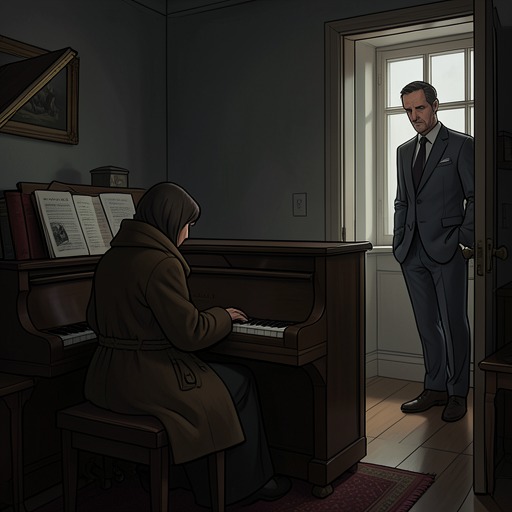
The Von Riesen family piano
All My Puny SorrowsThe Von Riesen family piano is both a forbidden presence in the Von Riesen household and the instrument through which Elfrieda Von Riesen makes her musical ambition audible. Hidden from the authorities of East Village, it first serves as a private outlet and then becomes the center of a performance staged, whether intentionally or by coincidence, while church elders are questioning the family. Its history gathers the pressures around Elfrieda—religious discipline, expectations for girls, and the possibility of a life beyond the community—into one object she can play.
A concealed instrument in East Village
The piano stood in a spare bedroom beside the front door, a room where Elfrieda’s life largely took place during that period. Its presence was against local rules: pianos were considered too suggestive of saloons, speakeasies, and unrestrained pleasure. The family nevertheless brought one into the house after a city doctor recommended a creative outlet for Elfrieda’s energy, hoping to prevent her from becoming what the community called wild. The word carried a particular threat in a society organized around compliance.
For several years, the parents concealed the instrument whenever elders visited, covering it with sheets and gunny sacks. The concealment was practical, but it also marked the family’s position between communal authority and Elfrieda’s need for music. Her parents did not simply tolerate her playing: over time they grew to love it and sometimes asked for familiar songs, including Moon River and When Irish Eyes Are Smiling. Their requests make the piano a domestic presence as well as a secret. What had entered the home as a doctor’s measure against unruliness became part of family life.
The authorities eventually discovered that the family had a piano. They discussed possible punishment for the father, including a period of excommunication, but relented after he readily offered to accept it. Their condition was that the parents ensure Elfrieda used the instrument only for religious purposes. The piano was thus permitted only under a constraint that could not contain what the music meant to her.
The performance before the elders
When church authorities came to the house over Elfrieda’s plan to study music at university, she was fifteen. The elders had heard that she wanted to leave the community and were suspicious of higher education, particularly for girls. As the discussion continued in the living room, Elfrieda began playing Rachmaninoff’s Prelude in G Minor, Op. 23 in the spare bedroom. She had studied the piece for two years with a conservatory teacher from Winnipeg who drove to the house twice a week.
The playing changed the balance of the visit. The men stopped speaking; the music grew louder, then quieter, then louder again. Elfrieda’s mother began humming and swaying, while the narrator recalls the surrounding birds and flies falling silent. The piano did not merely furnish the family with music: in that moment, its sound interrupted the elders’ authority and made Elfrieda’s intensity impossible to reduce to a discussion of rules. Her sister understands the performance as the moment Elfrieda took control of her life, and as the beginning of her emergence as an adult woman and, in retrospect, a world-class pianist.
When the piece ended, the piano top slammed shut and the bench scraped across the linoleum. Elfrieda came into the kitchen, drank the remaining apple juice, and declared that she had finally mastered the piece. The men left without further confrontation; her father withdrew to his study. The narrator cannot establish whether Elfrieda knew they were listening or chose that precise moment deliberately. The uncertainty matters: the performance’s effect is clear even if its intention is not. The piano made a decisive act of self-expression possible without confirming that it had been planned as one.
Practice, attention, and return
The instrument also shaped the sisters’ ordinary childhood. While Elfrieda practised scales, her sister could put raisins on the keys and watch her brush them away without breaking concentration. She could even lie on top of the piano and sing, while Elfrieda continued playing with her attention fixed on the keys. These recollections show a discipline so complete that the piano seemed to claim Elfrieda’s concentration even amid her sister’s interruptions.
The narrator describes the playing as capable of changing pace: Elfrieda’s eyes might close briefly in rapture, then open as she threw herself back into the music. The piano was not simply a tool for rehearsing pieces. It provided a structure for sustained attention and a way for Elfrieda to enter an intensity that ordinary conversation did not capture. Elsewhere, after concerts, she would talk for hours about mundane things, as though returning to everyday life through speech. The contrast gives the instrument a lasting role in the account of how she moves between musical absorption and the world around her.
After returning from Norway and other places, Elfrieda went through a period of staying in bed, crying, or staring at the wall. Her sister visited with her young children; later, as Elfrieda gradually regained her health, she began playing again and giving concerts. The piano therefore belongs not only to the earlier crisis of departure but also to her resumption of musical work. Its recurrence links a childhood practice, a period of profound distress, and a renewed public life without suggesting that playing by itself explains or cures her condition.
A shared instrument and a private bond
The piano also brings Elfrieda and Nic together. Nic took lessons from her for a few months, and later admitted that he had mainly wanted to sit beside her on the small bench and have her place his fingers on the keys. He bought her a new bench, but when she saw its soft padding she ordered him to remove it. The episode makes the instrument a setting for their closeness, while its unpadded bench reflects Elfrieda’s particular insistence on how playing should feel and be approached.
Nic is a precise person who trusts manuals, recipes, and exact sizes; Elfrieda’s suggestion that he learn to play around the notes delighted him by opening up a less orderly kind of music-making. Their different temperaments meet at the piano, where instruction becomes intimacy and precision encounters improvisation. The family instrument’s significance thus extends beyond the confrontation with the elders: it remains part of Elfrieda’s connection to music and to the people who share her life.
Significance
Across these episodes, the piano changes from a concealed object into an instrument of audible independence, then into a setting for practice, recovery, and companionship. Its physical presence matters—the coverings, the keys, the closing top, and the scraped bench all locate music within the household—but its larger importance lies in what playing allows Elfrieda to express. The elders could stipulate what purpose the piano was supposed to serve; they could not control the force of the performance that sounded from it. The instrument gives the novel a concrete measure of the divide between communal conformity and Elfrieda’s unruly, self-directed musical life.